Evaporative Coolers and Their Ducts
The short of it
Evaporative cooler ducts carry far more air than air-conditioning ducts, so they run larger, and the house needs open windows or relief vents to let that air out; humidity and hard water set the rest of the limits.
Valley Home Ducts, figures checked against their sources · updated
This page links to SoftPro Water Systems, which has the same owners as Valley Home Ducts. Those links are examples only; no figure here depends on them. About these links
On this page
- How does a ducted evaporative cooler work?
- Why do evaporative cooler ducts need to be bigger?
- Why must windows or relief vents open on a ducted evaporative cooler?
- When does Valley humidity stop an evaporative cooler?
- How does hard water affect an evaporative cooler?
- What about smoke days and winter?
- Questions from the field
What to carry away
- A direct evaporative cooler can drop the temperature of incoming air by 15°F to 40°F, according to the PNNL Building America Solution Center.
- Coolers are sized in CFM, with makers suggesting about 20 to 40 air changes per hour, not in tons like an air conditioner.
- The relief rule of thumb is 2 square feet of unrestricted opening for every 1,000 CFM of cooler air (PG&E, 2004, via PNNL).
- As a general rule, areas with design wet-bulb temperatures of 70°F or lower suit evaporative cooling (PNNL).
- A bleed-off valve for mineral-heavy water can raise water use by 10% to 50% (PNNL).
- USGS calls water above 180 mg/L as calcium carbonate "very hard."
How does a ducted evaporative cooler work?
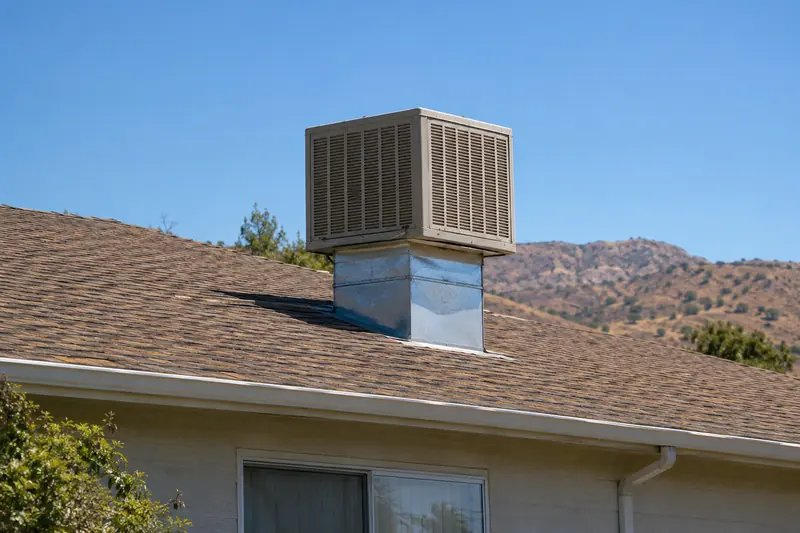
A ducted evaporative cooler pulls outdoor air through wet pads on the roof or beside the house, cools it by evaporation, and blows it through ducts into the rooms. The PNNL Building America Solution Center says the moving air "evaporates some of the water, which can reduce the temperature of the air entering the home by 15°F to 40°F."
Unlike air conditioning, a direct cooler adds moisture rather than removing it, and it is a once-through system: every cubic foot it pushes in has to leave again through windows or vents.
PNNL says ducted systems "are needed for larger houses with hallways and multiple bedrooms." PNNL also says coolers can use about one-fourth as much energy as central air; they use water instead.
Why do evaporative cooler ducts need to be bigger?
Evaporative cooler ducts need to be bigger because a cooler moves several times more air than a central air conditioner in the same house. PNNL says coolers "are not sized by 'tons of cooling'" but by airflow, using the formula cooler CFM = (cubic feet × air changes per hour) ÷ 60, with makers suggesting "around 20 to 40 ACH through the conditioned space."
Run the numbers for a 1,500-square-foot ranch house with 8-foot ceilings, or 12,000 cubic feet. At 20 air changes per hour the formula gives 4,000 CFM; at 40 it gives 8,000 CFM. A 3-ton central air conditioner at the roughly 350 to 450 CFM per ton that DOE's Building America guide describes moves about 1,050 to 1,350 CFM. Three or more times the air needs a lot more duct cross-section to move it.
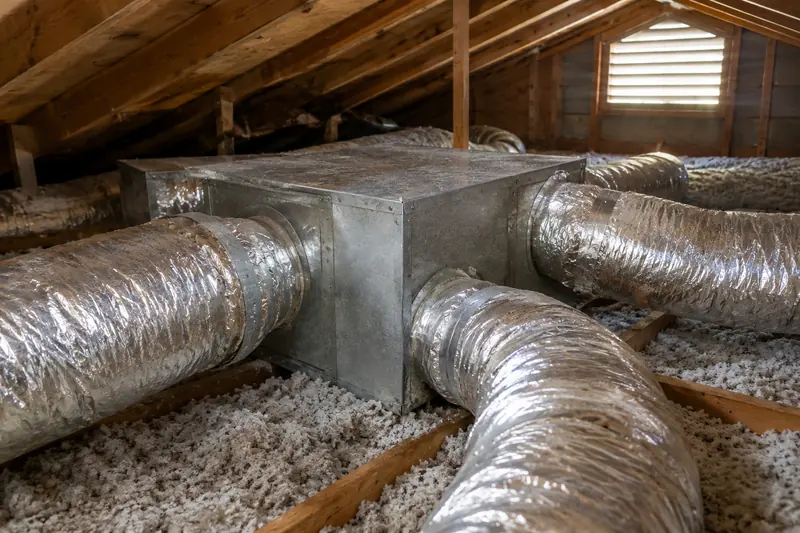
Reusing air-conditioning ducts for a cooler is therefore a design question, not a swap. PNNL tells designers to lay out "a compact duct layout in accord with ACCA Manual D." The Valley Home Ducts page on Manual D duct sizing explains what that design involves, and the mini-split comparison covers another option.
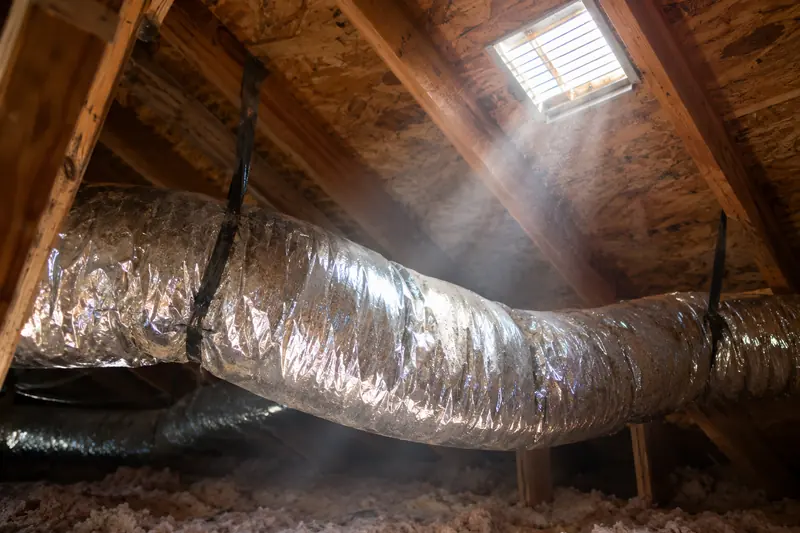
Cooler ducts in a Valley attic bake like any other duct, so duct insulation and tight joints matter here too.
| Question | Ducted evaporative cooler | Central air conditioner |
|---|---|---|
| How it is sized | CFM, about 20–40 air changes per hour | Tons, about 350–450 CFM per ton |
| Air path | Once through: in from outside, out a window or vent | Recirculated through a return |
| Humidity indoors | Goes up | Goes down |
| Energy | About one-fourth of central air (PNNL) | Compressor plus fan |
| Water | Evaporation plus any bleed-off | Condensate only |
| Best climate | Design wet-bulb 70°F or lower (PNNL) | Works in humid weather too |
Why must windows or relief vents open on a ducted evaporative cooler?
Windows or relief vents must open because a cooler blows outdoor air in and has no return; if the air cannot get out, delivery falls off. PNNL puts it plainly: "doors or windows must be opened to provide a path for the air to exit."
The rule of thumb PNNL cites from PG&E (2004) is 2 square feet of unrestricted relief for every 1,000 CFM. For the 4,000 CFM example above, that is about 8 square feet of open window or vent. PNNL adds that screens and louvers restrict airflow, "so vent area must be increased."
Relief can also go through ceiling vents into a vented attic; PNNL says these vents "usually come with a barometric damper that automatically opens when the cooler is on," and that dampers should be closed during the heating season.
When does Valley humidity stop an evaporative cooler?
An evaporative cooler loses its punch as the wet-bulb temperature rises, because the air can take up less water. PNNL says "areas with wet-bulb temperatures of 70°F or lower are appropriate for evaporative cooling," and that coolers can still help where coincident wet-bulb temperatures reach about 74°F.
The examples PNNL reproduces show the swing. On a 100°F day at 10% relative humidity, a cooler can deliver about 73°F air; at 95°F and 50% relative humidity, the supply air is about 84°F (Home Energy, 1996).
No source read for this page gives a design wet-bulb figure for the four Valley cities, so none is stated here. The heat is documented: NOAA's 1991–2020 normals give Stockton a 95.4°F July average high and Fresno 97.7°F (NOAA NCEI). On muggy days, check the relative humidity in your local forecast; the higher it is, the warmer the cooler's air will be. The Valley climate zones page covers the rest of the local weather.
How does hard water affect an evaporative cooler?
Hard water leaves minerals on the pads and in the pan, because evaporation takes the water and leaves the rest. PNNL warns that "debris, rust, and calcification can all diminish efficiency and performance," and that cooler cabinets are "very susceptible to rusting and calcification."
The usual fix is dumping some water on purpose: PNNL says a bleed-off valve helps where water is mineral-heavy, though "this can increase water usage by 10% to 50%." An auto-flush system, also called a dump pump, empties the reservoir about "every 8 to 12 hours of operation" and uses less water than continuous bleed-off.
The USGS defines hardness as "the amount of dissolved calcium and magnesium in the water" and classes 0 to 60 mg/L as soft, 61 to 120 as moderately hard, 121 to 180 as hard, and more than 180 as very hard. Knowing your own number helps: SoftPro Water Systems' page on testing water hardness at home (SoftPro Water Systems, same owners as Valley Home Ducts) walks through simple checks, and a measured figure guides bleed-off and descaling. It is not a reason to soften cooler water.
PNNL says maintenance should happen "at least twice a year," with pads cleaned or replaced and deposits removed; it suggests vinegar for calcification. Switch the cooler off at its switch or breaker before touching pads or the pan, and leave the motor wiring alone. If you're unsure, call a licensed technician.
What about smoke days and winter?
A cooler pulls outdoor smoke straight in, and CARB's Smoke Ready advice for Californians is simply not to run swamp coolers while smoke lingers. The EPA gives a fallback for places where a cooler is the only cooling: if you can safely reach the cooler, "completely cover the outside air intakes with 4-inch-thick high-efficiency (MERV 13) furnace filters"; if you cannot, use the cooler sparingly "because it can bring more smoke inside." See smoke-season settings for central systems.
In winter, close it up. PNNL says to drain and dry the cooler, install a winter cover, and "close dampers if the unit is centrally ducted," so warm house air does not escape up the cooler duct during tule-fog season. Roof work is ladder work; many owners hire it out.
Evaporative cooler numbers
- 15–40°Fdrop in incoming air temperaturePNNL BASC
- 2 sq ftrelief opening per 1,000 CFMPG&E (2004) via PNNL BASC
- 10–50%extra water use with a bleed-off valvePNNL BASC
- 180 mg/Labove this, USGS calls water very hardUSGS
How this page was put together
This page relies on the PNNL Building America Solution Center's evaporative cooling guide (which cites PG&E 2004, SWEEP 2007 and Home Energy 1996), DOE Building America's duct guide, EPA wildfire guidance, the USGS hardness page and NOAA 1991–2020 normals, all read in October 2026. University of Arizona Extension cooler handouts could not be opened (the repository refused connections on October 28, 2026), so none are used. The duct-size example is arithmetic on PNNL's sizing formula and DOE's airflow range, not a measured house. No Valley wet-bulb figure is given because no source read states one.
Questions from the field
Can an evaporative cooler use my existing air-conditioning ducts?
Usually not as-is. A cooler sized at 20 to 40 air changes per hour moves several times the airflow of a typical central air conditioner, so the ducts need to be designed for it. Ask a licensed contractor for a duct design before connecting the two.
How far should I open the windows?
Use PNNL's 2 square feet per 1,000 CFM, and open more when screens cover the windows. PNNL notes that opening windows only in the rooms you want cooled gives some zoning.
Does an evaporative cooler make the house humid?
Yes, a direct cooler adds moisture to the air it delivers, which is why it works best on dry days. The muggier the day, the less cooling you get.
How much water does a cooler use?
It depends on the cooler, the weather and the bleed-off. A SWEEP (2007) study cited by PNNL estimated 2,980 gallons a year in Santa Fe to 12,457 in Las Cruces without a bleed-off valve, and 50% more with one. No Central Valley figure was found.
Do I need to close the cooler in winter?
Yes: drain it, cover it and close the dampers on a ducted unit, and keep ceiling relief dampers shut while the heat is on (PNNL).
Is an indirect cooler different?
Yes. PNNL says indirect coolers use an air-to-air heat exchanger, so they do not add humidity to the cool air, and two-stage indirect/direct units deliver air that is cooler and drier than a single-stage cooler's.
Related pages