Flex Duct vs Sheet Metal
The short of it
Flex duct vs sheet metal comes down to installation: flex works when it is stretched tight and supported at least every 4 feet, while sheet metal keeps its shape but has more joints to seal.
Valley Home Ducts, figures checked against their sources · updated
This page links to PlumbingSupplyAndMore, which has the same owners as Valley Home Ducts. Those links are examples only; no figure here depends on them. About these links
On this page
What to carry away
- The Air Duct Council's flex standard, summarized by PNNL, calls for supports no more than 4 feet apart and sag of no more than half an inch per foot.
- ADC's slides show 15% compression roughly doubling a flex duct's pressure drop, 30% roughly quadrupling it and 45% raising it 6 to 8 times.
- ADC says to keep flex bends no tighter than one duct diameter, and ADC has since published a 6th edition of its standard.
- LBNL's duct-sealing slides put basement rectangular metal at about 30% leakage per side of the fan, against about 15% for attic round metal or flex.
- Joints use different listings: UL 181A for rigid duct closures, UL 181B for flex (181B-FX tape, 181B-M mastic), per DOE Building America and ADC.
- Any new attic duct in climate zones 12 and 13 needs R-8 insulation under Title 24.
How do flex and sheet metal ducts differ?
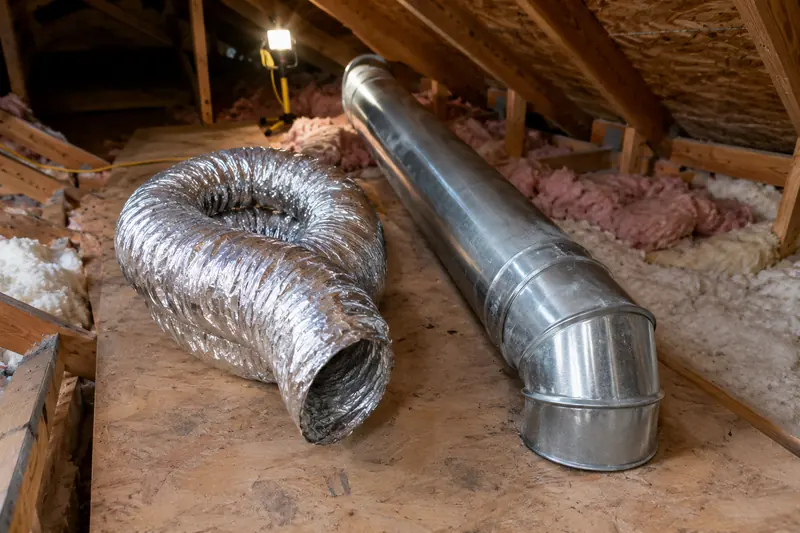
Flex duct is a wire-coil inner core wrapped in insulation and an outer jacket, while sheet metal duct is rigid galvanized steel, round or rectangular, that is insulated on the outside. Flex goes in fast and bends around trusses. Sheet metal holds its shape and has a smooth inside, but every seam and fitting is a joint that has to be sealed.
Neither material is good or bad on its own. LBNL's duct-sealing slides contrast basement rectangular metal, where "Many joints = many leaks" ran about 30% per side of the fan, with attic round metal or flex, where fewer joints meant about 15% per side. The same slides note that for insulated ducts outside the conditioned space, about 90% of the energy lost is not recovered. In a Valley attic, where you put the duct matters as much as what it is made of.
There's no primary head-to-head study behind the claims you'll hear about friction or lifespan, and Valley Home Ducts didn't find one. What the standards do give is a clear set of rules for installing flex well, and those decide most of the difference.
Why does compressed flex lose airflow?
Compressed flex loses airflow because a squashed inner core folds into ridges that drag on the air, which raises the pressure the blower has to overcome. The Air Duct Council's slide summary, linked from PNNL's library entry, shows pressure drop at about 2 times normal with 15% compression, 4 times at 30% and 6 to 8 times at 45%. Its instruction is blunt: "Ducts should be fully extended before and during installation."
Sag and pinching do the same thing. PNNL lists the results of poorly supported flex as "minimal air flow to a terminal, excessive noise, or fan burnout due to increased static pressure." ENERGY STAR's duct sealing page names "tangled or kinked flexible ducts" among its signs of a duct problem.
Looping is a related habit. PNNL's page on coiled or looped flex says "Some contractors intentionally loop the flexible duct as a way to decrease airflow to a particular room," and cites ENERGY STAR guidance that balancing dampers or proper duct sizing "shall be used instead." The balancing page covers dampers.
What are the flex duct installation rules?
The core rules are full extension, supports at most 4 feet apart, limited sag, wide straps and gentle bends. ADC's 5th edition, as summarized by PNNL, sets them out:
- Supports: straps at least 1-1/2 inches wide at intervals of no more than 4 feet, with sag of no more than 1/2 inch per foot of support spacing.
- Straps: PNNL says "Straps should not compress the inner core or constrict air flow."
- Bends: "Keep bends greater than or equal to one (1) duct diameter," in ADC's wording.
- Length: stretched fully, with no extra coiled in the attic.
- Joints: tapes or mastics listed to UL 181B, marked 181B-FX for tape or 181B-M for mastic.
The Air Duct Council has since produced a 6th edition of the standard; the figures here are from the 5th, the version PNNL summarizes. In dry climates like the Valley, PNNL's support page notes that flex may rest on ceiling joists and be covered with blown insulation, an approach its buried-duct guidance pairs with R-8 duct insulation and very tight ducts.
Where does sheet metal make sense?
Sheet metal earns its place where shape and durability matter: plenums, trunks, long straight runs and spots where a duct could be stepped on or crushed. A rigid trunk can't sag between straps, and its inside stays smooth.
The trade-off is joints. Each seam, collar and elbow needs sealing, and the DOE Building America measure guideline says many home energy experts "consider mastic superior to tapes in most situations." It identifies UL 181A as the listing for rigid duct closures. Cloth duct tape doesn't belong on either material; the mastic vs foil tape page explains why.
Older Valley houses sometimes have metal ducts with old wrap or tape. EPA notes that houses of the 1930s–1970s era are the likeliest to carry asbestos in duct wrap, tape or cement (transite) ducts. Don't cut, scrape or seal over suspect material; EPA says to leave it alone and have an accredited asbestos professional take samples. If you're unsure, call a licensed technician.
| Factor | Flex duct | Sheet metal duct |
|---|---|---|
| Shape in place | Depends on supports every 4 ft or less | Holds its shape |
| Main failure | Sag, compression, kinks, torn jacket | Leaky seams and fittings |
| Joint listing | UL 181B (181B-FX tape, 181B-M mastic) | UL 181A for rigid closures |
| Leakage seen by LBNL | About 15% per side (attic round metal or flex) | About 30% per side (basement rectangular metal) |
| Attic insulation in zones 12 and 13 | R-8 for new ducts | R-8 for new ducts |
What should a mixed flex and sheet metal system look like?
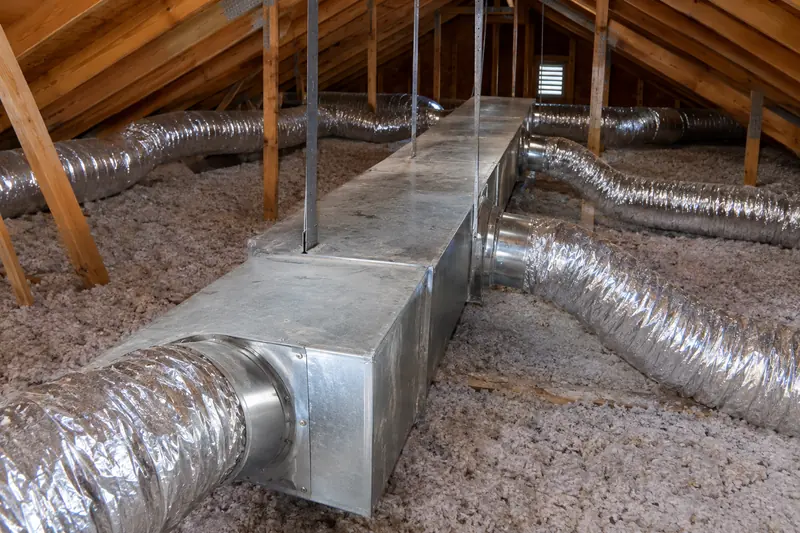
One common arrangement pairs a rigid plenum and trunk with short, straight flex branches to the registers, all sealed at every connection. Look for flex pulled taut, strapped at least every 4 feet, with no loops and no bends tighter than the duct's own width. Look for metal joints coated in mastic, not wrapped in cloth tape.
Every new attic duct also needs insulation. Stockton, Modesto and Sacramento sit in climate zone 12 and Fresno in zone 13, and Title 24 asks for R-8 on new attic ducts in both; the duct insulation page has the detail. Longer replacements also trigger leakage testing, covered on the replacing ductwork page.
A supply house's duct pipe listings show round metal pipe by diameter, and its duct fittings listings show the collars, elbows and boots that join metal and flex. Seeing them helps you read a bid; choosing them is the contractor's job.
Flex and metal figures
- 4 ftmaximum flex support spacingAir Duct Council via PNNL
- 15%compression at which flex pressure drop about doublesAir Duct Council via PNNL
- 30%leakage per side seen in basement rectangular metal ductsLBNL
- R-8new attic duct insulation in Stockton through FresnoTitle 24 (Energy Code Ace)
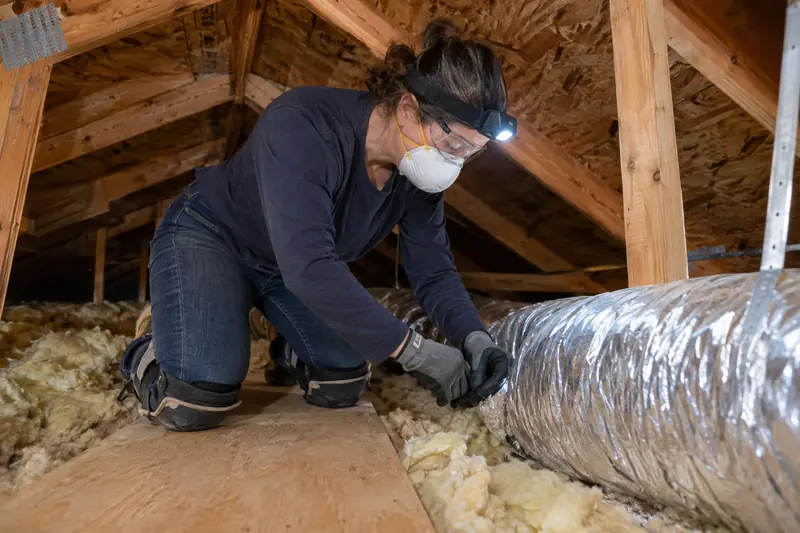
Before any attic look, go early in the morning in a cooler month, step only on joists or a board laid across them, watch for roofing nails overhead, wear gloves, long sleeves, safety glasses and a dust mask, and tell someone you're up there. The attic safety page covers heat illness signs.
How this page was put together
This page relies on these PNNL Building America Solution Center topics: flex duct support intervals, coiled or looped flex and the ADC flexible duct standard (5th edition, 2010), the Air Duct Council's standards page, LBNL's remote duct sealing slides, DOE's Building America duct measure guideline, ENERGY STAR's duct sealing page, EPA's asbestos page and the Title 24 text on Energy Code Ace, all checked in October 2026. Not included: friction or lifespan comparisons not backed by a primary source, duct-size charts and prices.
Questions from the field
Is flex duct allowed in California homes?
Yes. Title 24 sets leakage and insulation rules for new ducts rather than banning a material. Flex has to be installed to its standard and insulated to R-8 in climate zones 12 and 13.
Can I straighten a sagging flex duct myself?
Re-hanging a reachable run with wide straps is within reach for a careful homeowner working early in the morning in a cooler month, but a disconnected or torn duct is a contractor job. Never step between joists, and leave suspect asbestos materials alone.
Does flex duct wear out?
The outer jacket and insulation can tear or be damaged by animals, and old cores can come loose from their collars. Have a contractor inspect runs that are crushed, torn or disconnected.
Is sheet metal always quieter?
Not always. Noise depends on air speed, fittings and installation as much as material. A well-sized system in either material should not roar.
Why do installers loop extra flex?
Sometimes to cut airflow to a room, and sometimes to avoid cutting the duct to length. PNNL cites ENERGY STAR guidance to use balancing dampers or proper sizing instead.
Can flex be buried in attic insulation?
In the Valley's dry air, PNNL treats burial as an option, provided the ducts carry R-8 or higher wrap and leak very little. That call belongs in the contractor's design.
Keep reading


Back to the Valley Home Ducts front page