Questions to Ask a Duct Contractor
The short of it
The questions to ask a duct contractor cover five things: a current CSLB license, a permit, a load and duct design, Title 24 leakage numbers in writing, and a combustion safety test when gas appliances share the house.
Valley Home Ducts, figures checked against their sources · updated
This page links to Central Plumbing HVAC, which has the same owners as Valley Home Ducts. Those links are examples only; no figure here depends on them. About these links

On this page
- What questions should you ask a duct contractor before hiring?
- How do you check a duct contractor's license?
- What should a duct contractor's written bid show?
- Which red flags should end the conversation?
- What safety questions belong on the list?
- What should you get at the end of the job?
- Questions from the field
What to carry away
- In California, anyone bidding on a job worth $1,000 or more in labor and materials combined must hold a CSLB license.
- Duct and HVAC work falls under the CSLB's C-20 classification, which must carry workers' compensation even without employees.
- The CSLB says to pay no more than 10% down or $1,000, whichever is less, and to get at least three bids.
- After a changeout, Title 24 allows 10% or less total duct leakage, or 7% or less to outside (Energy Code Ace).
- ENERGY STAR asks contractors to run a combustion safety test after ducts are sealed.
- A state-certified ECC-Rater (the 2025 code's title for a HERS Rater) verifies the test and issues a CF3R certificate.
What questions should you ask a duct contractor before hiring?
Start with the questions that separate a design from a guess: who pulls the permit, how the system is sized, and how leakage is measured. Ask these first:
- Will you pull the permit and schedule the inspection? The CSLB's construction project checklist says "The contractor should pull all necessary permits."
- Will you do a load calculation? ACCA says Manual J "gives you the loads for single-family detached homes," and Manual S "helps you choose the appropriate heating and cooling equipment."
- Will new or changed ducts be designed to Manual D? ACCA describes it as offering "ANSI-approved standards for duct design." See Manual D duct sizing.
- Which leakage target applies to this job, and who tests it?
- Do you have employees, and do you hire licensed subcontractors? Both questions come straight from the CSLB checklist.
How do you check a duct contractor's license?
Look it up yourself on the CSLB's Check a License page, by license number, business name or the name of a person on the license. The CSLB's own HVAC consumer page tells homeowners to "be sure your contractor holds an active C-20 Warm-Air Heating, Ventilating, and Air-Conditioning license."
The C-20 definition includes "the ducts, registers, flues" and filters tied to heating and cooling systems. On the license detail, check that it is active, that C-20 is listed, and the workers' compensation entry. The CSLB brochure notes that C-20 contractors "must have a workers' compensation policy regardless of whether they have employees."
The threshold is low: a license is required at $1,000 in combined labor and materials, or for any job needing a permit or workers. The CSLB also suggests asking to see the pocket license and a photo ID.
What should a duct contractor's written bid show?
A written bid should name the equipment, the duct work, the tests and the paperwork. The CSLB requires a written contract for home improvement projects over $500, and says it should "identify the contractor, their business address, and contractor license number" (CSLB contracts page).
For duct work, look for these lines:
- The code target. After a changeout, Title 24 wants the connected ducts at 10% or less total leakage, or 7% or less to outside; failing both, every accessible leak gets sealed and checked by eye and with a smoke test. An entirely new duct system must reach 5% or less. The Title 24 changeout page has the details.
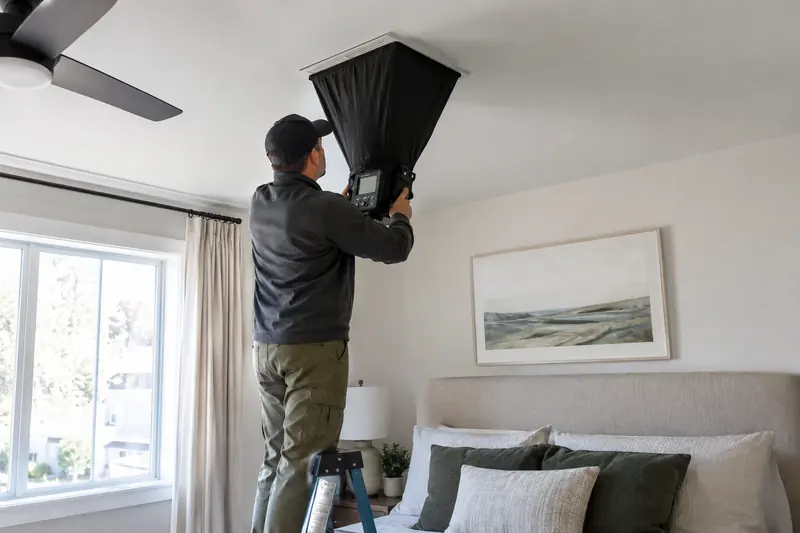
- The test, before and after. Ask for the measured leakage in writing as a number, not "passed." See the duct leakage test page.
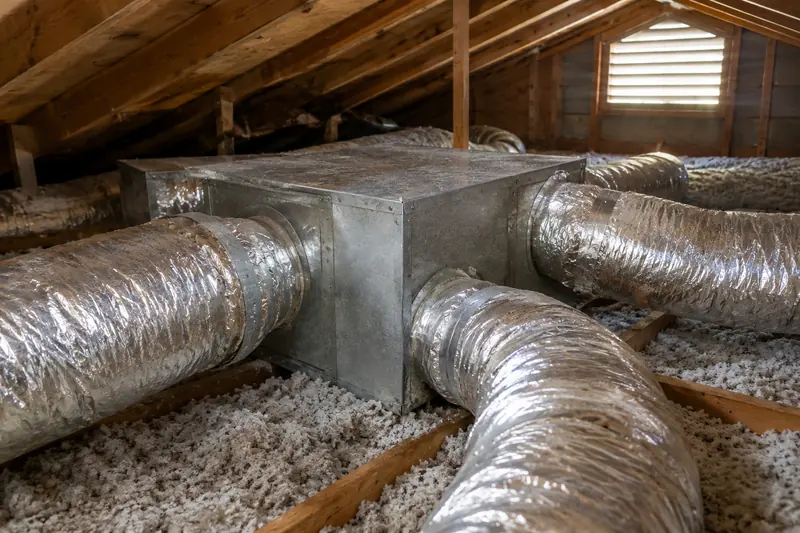
- The sealing method. Mastic or UL 181-listed foil tape, never cloth duct tape (mastic vs foil tape).
- Insulation. New attic ducts in Stockton, Modesto, Sacramento or Fresno need R-8 under Title 24.
- Airflow and charge. On a refrigerant-side changeout in zones 12 and 13, Title 24 requires airflow and charge verification, with a minimum of 300 CFM per ton (Energy Code Ace).
- Payment schedule. The CSLB says the down payment "cannot be more than $1,000 or 10 percent of the contract price, whichever is less," and payments "cannot exceed the value of the work performed."
| Item | What to ask for | Who sets it |
|---|---|---|
| License | Active C-20 on the license detail | CSLB |
| Permit | Contractor pulls it and books the inspection | Local building department (CSLB checklist) |
| Load and design | Manual J load; Manual D for new ducts | ACCA |
| Leakage after a changeout | 10% total or 7% to outside, in writing | Title 24 §150.2(b)1E |
| Duct insulation | R-8 for new attic ducts in all four cities | Title 24 |
| Down payment | 10% or $1,000, whichever is less | CSLB |
| Combustion safety | Test before and after sealing | ENERGY STAR; DOE Building America |
Which red flags should end the conversation?
Walk away from anyone who will not put the license number, leakage target or payment schedule on paper. The CSLB's own advice doubles as a list of warning signs: door-to-door or high-pressure sales, a request to pay in cash, payments that run ahead of the work, and no pocket license to show.
A few duct-specific ones:
- "No permit needed for a changeout." Treat a permit as standard practice.
- "Testing is optional." The changeout rule exempts just three cases: earlier verified sealing, under 40 linear feet of duct, or asbestos.
- A duct-cleaning upsell sold as a health fix. EPA finds no proof that cleaning prevents illness; see duct cleaning claims.
- Advice to shut registers in empty rooms to save power. LBNL modeling of California homes found the opposite.
What safety questions belong on the list?
Ask how the crew will handle combustion safety, asbestos and the attic before work starts. These questions protect the people in the house, not only the bill.
Combustion safety. Sealing ducts can change pressures around a gas furnace or water heater. The ENERGY STAR duct-sealing flyer tells contractors to "conduct a combustion safety test after ducts are sealed," and DOE's Building America guide says testing "should be conducted both before and after duct sealing." Ask for both results, and keep CO alarms on every level. If a CO alarm sounds or you smell gas, leave the building first, don't use switches or phones inside, and call 911 or the gas utility from outside.
Asbestos. Homes built roughly from the 1930s to the 1970s may have asbestos duct wrap or tape. The EPA says "If you suspect material contains asbestos, don't touch it," and an accredited professional should take samples. Ask whether the crew will stop and call one if they find suspect wrap.
The attic. Ask how the crew handles summer attic heat; the attic safety page covers what the work involves. If you're unsure, call a licensed technician.
Gas appliances themselves stay off the homeowner's list: no work on burners, flues or gas lines.
What should you get at the end of the job?
At the end you should hold a closed permit, the test results and the rater's certificate. On a changeout, a state-certified ECC-Rater (called a HERS Rater before the 2025 code) verifies the duct test and signs the CF3R; SMUD makes that certificate a condition of its heat pump rebate. The ECC-Rater visit page explains what the rater does.
Also ask for combustion test results, airflow and charge readings, and warranty papers. The CSLB suggests keeping payments, photos and documents in a job file and holding the final payment until you are satisfied with the work.
Company service pages can show what a contractor says it handles. Central Plumbing HVAC's heating page (Central Plumbing HVAC, same owners as Valley Home Ducts), for one example, says it will "handle all required permits and inspections"; that company works in Bucks and Montgomery counties in Pennsylvania, not the Valley. In the Valley, look for a CSLB-licensed C-20 contractor near you and get the same promise in writing.
Hiring numbers from California sources
- $1,000job value that requires a CSLB licenseCSLB (2025)
- 10%maximum down payment, or $1,000 if lessCSLB
- 3bids to collect before choosingCSLB (2025)
- 7%duct leakage to outside allowed after a changeoutTitle 24 (2025)
How this page was put together
This page is based on CSLB pages and two 2025 CSLB brochures, Energy Code Ace's copy of the 2025 code, ACCA, ENERGY STAR, DOE Building America, EPA, LBNL and SMUD; everything was read in October 2026. It does not rate or recommend any contractor, quote prices, or name ECC-Rater providers.
Questions from the field
Is a HERS Rater the same as an ECC-Rater?
Yes, for practical purposes: the 2025 Energy Code renamed the role, and the 2022 code used "HERS Rater." A permit filed in 2026 or later is under the 2025 code.
Does replacing only the air handler trigger the duct test?
Yes. Title 24 ties the duct sealing rule to any of the three main parts: indoor fan unit, outdoor unit or coil. A fan-unit-only swap skips the refrigerant charge check, which starts when refrigerant-containing parts change.
What if my ducts can't reach 10% or 7%?
The fallback is sealing every accessible leak, verified by eye and with a smoke test. Ask the contractor to say in writing which path the job took.
Can a handyman do duct sealing in California?
Only on small jobs: the CSLB requires a license for work of $1,000 or more in labor and materials combined, or any job needing a permit or workers. A changeout with duct testing needs a licensed C-20 contractor.
How many bids should I get for duct work?
The CSLB says at least three, with references. Ask each bidder to price the same scope; a bid that skips the test or the permit is a different job, not a cheaper one.
Does a duct contractor need EPA 608 certification?
Duct sealing alone does not involve refrigerant, but a changeout that touches the coil or line set does. Anyone handling refrigerant must hold EPA Section 608 certification. Ask who on the crew holds it.
Keep reading

Back to the Valley Home Ducts front page