Duct Insulation R-Values for Hot Attics
The short of it
Duct insulation for attic ducts in Stockton, Modesto, Sacramento and Fresno should be R-8, the Title 24 value for new ducts in climate zones 12 and 13; older houses often carry R-4 wrap or none.
Valley Home Ducts, figures checked against their sources · updated
This page links to PlumbingSupplyAndMore, which has the same owners as Valley Home Ducts. Those links are examples only; no figure here depends on them. About these links
On this page
What to carry away
- The 2025 Energy Code, as reproduced on Energy Code Ace, sets R-8 for new ducts in unconditioned space in climate zones 1, 2, 4 and 8 through 16, and R-6 only in zones 3 and 5–7.
- Stockton, Modesto and Sacramento sit in climate zone 12 and Fresno in zone 13 on the state's building climate zone map, so all four cities fall under R-8.
- DOE Building America (2011) notes older homes may have R-4 duct insulation or none.
- Fiberglass duct wrap runs R-2.5 to R-4 per inch, depending on product and density, per the same guideline.
- PNNL's Building America Solution Center says buried ducts can be used in dry climates, with R-8 or better duct insulation and a vapor barrier.
- SMUD's heat pump rebate requires any new ductwork to be insulated to R-8 or higher.
What R-value does attic duct insulation need?
Attic duct insulation in the Valley needs R-8 when ducts are new or replaced. Title 24 Part 6 points new ducts in unconditioned space, which includes attics, crawlspaces and garages, to its duct insulation table: R-8 in climate zones 1, 2, 4 and 8–16, R-6 in zones 3 and 5–7. The rule kicks in once a job adds or replaces over 25 feet of duct, and the values match in the 2022 and 2025 editions.
ENERGY STAR's flyer gives a national rule of thumb of R-6 or higher for ducts in unconditioned areas. That is a floor for the whole country, written for basements in Ohio as much as attics in Fresno. Here the code number is R-8, and nothing on this site treats the lower figure as good enough for Valley attics.
Why do Valley ducts need R-8 insulation?
Valley ducts need R-8 because a Valley attic is one of the hottest places a duct can sit. DOE Building America says attics can easily reach 130°F or 140°F on hot summer days, while the air inside a cooling duct leaves the coil at 50–55°F: a gap of at least 80°F across a jacket an inch or two thick.
The heat load is long, too. NOAA's 1991–2020 normals give Fresno's Yosemite International Airport a July average high of 97.7°F and about 38 days a year at 100°F or more; Stockton's airport averages 95.4°F in July. Climate zones 12 and 13 are on the climate zones page; confirm your own address, since one near a zone line can differ.
Every degree a supply duct gains in the attic is cooling the house never feels. LBNL's duct sealing slides put it bluntly for insulated ducts outside the house: about 90 percent of the energy lost is not recovered. The attic heat page works through the rest.
What does older duct insulation look like?
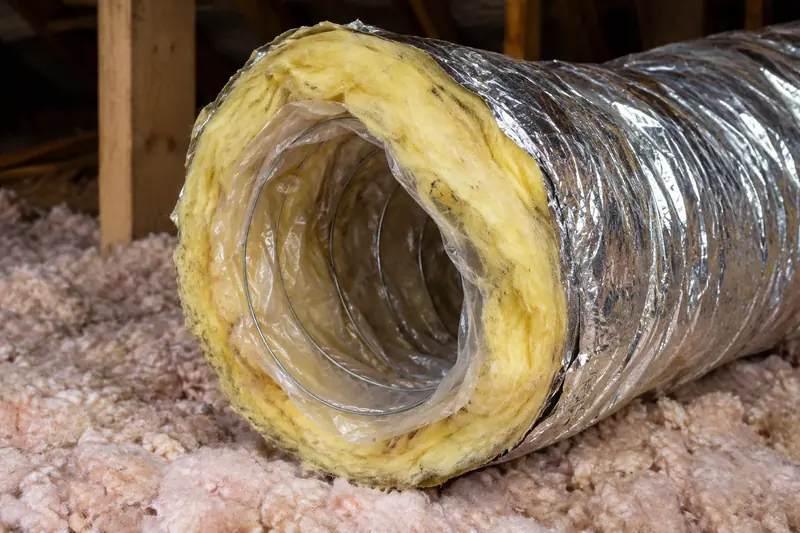
Older duct insulation is usually a fiberglass blanket wrapped around sheet metal, often with a foil or kraft facing, and it is often thinner than code asks for today. DOE's Building America guideline describes duct wrap as sheets 2–4 feet wide and 1–4 inches thick with a vapor barrier on the outside, rated R-2.5 to R-4 per inch. It adds that older homes may have R-4 duct insulation or none at all.
Look for the printed R-value first; flex duct and duct board usually carry it on the surface. Then look for trouble: torn or sagging facing, wrap held on by failing tape, crushed sections where someone crawled across, and bare sheet metal at elbows. Uninsulated flex is a red flag on a supply run in an attic; the guideline says it is not recommended there and notes it turns up in systems installed by laypeople.
Stop if the house was built between the 1930s and 1970s and the wrap, tape or duct material is anything you cannot identify. The EPA lists furnace duct insulation among possible asbestos sources and says that if you suspect asbestos, don't touch it; an accredited professional takes samples. If you're unsure, call a licensed technician.
Should ducts be buried in attic insulation?
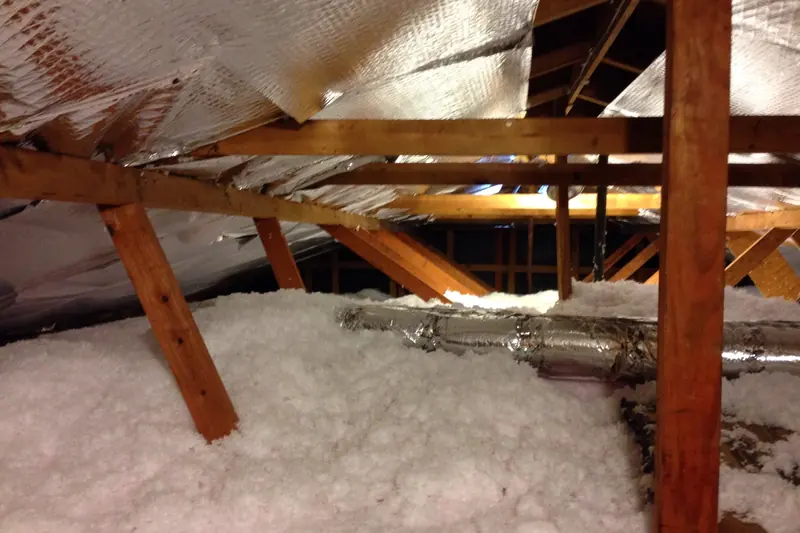
Buried ducts can work in the Valley's dry climate, but only when the ducts are sealed tight and the job is part of a larger attic project. PNNL's Building America Solution Center says buried ducts can be used in dry climates and calls for R-8 or higher duct insulation with a vapor barrier and total leakage under 3 CFM25 per 100 square feet of conditioned floor area. In humid or marine climates it asks for closed-cell spray foam on the ducts first.
The same page says the best place for ducts is inside the conditioned space; burial is the next best thing for ducts that stay in the attic. DOE Building America cautions that burying may not be practical in an existing home unless attic insulation and air sealing are already on the list. Sacramento readers in SMUD territory can check its Seal and Insulate program, which lists deep-burying ducts and up to $3,000, subject to funding. The conditioned-space page covers the other options.
When should you re-insulate ducts instead of replacing them?
Re-insulate when the duct itself is sound, sealed and well supported, and only the wrap is thin, torn or missing. DOE Building America says that if insulation is torn or has a low R-value, new insulation after sealing may be worthwhile, and that small tears in a vapor barrier can be closed with foil tape while larger damage is covered with fresh wrap that has an intact barrier.
Replace when the duct is the problem: crushed or kinked flex, runs with no support, or a layout that never delivered enough air. A complete new duct system must test at 5 percent leakage or less under Title 24. The replacement page and flex vs sheet metal page cover that path.
Order matters either way: seal first, then insulate. Wrap installed over open joints only hides the leaks for years.
How is duct wrap put on properly?
Duct wrap goes on loose, overlapped and held mechanically. DOE Building America's steps: measure the duct's perimeter and add 2 inches, trim 2 inches of fiberglass from the overlapping edge, wrap without heavy compression at the corners, staple the overlapped facing, and tape the seams to tighten the vapor retarder. Tape alone may not carry the weight of insulation, so support matters.
Whatever the product, read the R-value printed on it; for new ducts in a Valley attic, look for R-8. Rigid fiberglass duct board (PlumbingSupplyAndMore, same owners as Valley Home Ducts), where the duct wall is itself the insulation, carries an R-value the same way. Wear gloves, a dust mask, safety glasses and long sleeves around fiberglass, and see the attic safety page before going up.
| Level | Where it comes from | Fits Valley attics? |
|---|---|---|
| None | Some older houses and layperson flex installs | No |
| R-4 | Common on older wrap, per DOE Building America | No; below code for new work |
| R-6 | ENERGY STAR national minimum; Title 24 in zones 3 and 5–7 | No; zones 12 and 13 call for R-8 |
| R-8 | Title 24 in zones 1, 2, 4 and 8–16; BASC buried-duct spec; SMUD rebate rule | Yes |
- R-8Title 24 value for new attic ducts in Valley zonesEnergy Code Ace (2025 code)
- R-2.5–4per inch of fiberglass duct wrapDOE Building America
- 90%of lost attic duct energy not recoveredLBNL slides
- 97.7°FFresno July average high, 1991–2020NOAA NCEI
For the full row, start at the sealing and insulation hub.
How this page was put together
Sources, read in October 2026: Energy Code Ace's copies of the Title 24 Part 6 duct insulation values (both the 2022 and 2025 code), the CEC building climate zone map layer, NOAA NCEI 1991–2020 normals, the ENERGY STAR duct sealing flyer, DOE Building America's December 2011 duct guideline, PNNL's buried-duct guide, the EPA asbestos page and SMUD's program pages. Not included: dollar savings, which DOE modeled for Houston and Boston, and any code section or table number, since the table number changed between editions.
Questions from the field
Is R-6 duct insulation legal in Sacramento?
For new or replacement ducts in an attic, Title 24 calls for R-8 in climate zone 12, which includes Sacramento. The rule is tied to adding or replacing ducts, so ask the building department about any other project.
Does flex duct come with insulation?
Insulated flex is the common kind, and DOE Building America notes the R-value is typically labeled on the duct surface. Check that it reads R-8 for a Valley attic.
Can I add a second layer of wrap over old wrap?
Only over wrap that is dry, intact and not suspected asbestos, and only after the joints underneath are sealed. DOE's wrap steps warn against heavy compression, so don't crush the old layer.
Does duct insulation stop condensation?
DOE Building America says insulation reduces heat transfer and helps prevent condensation during cooling, which is why the vapor barrier facing must stay intact.
How thick is R-8 duct wrap?
At R-2.5 to R-4 per inch, R-8 takes roughly 2 to 3.2 inches of fiberglass, depending on the product. The printed label settles it.
Do return ducts need R-8 too?
Title 24 sets duct insulation by climate zone, and R-8 is the zone 12 and 13 value for new ducts in unconditioned space. The contractor or ECC-Rater on the job can confirm what each run requires.
Does the attic insulation over a ceiling count as duct insulation?
Only when ducts are deliberately buried to the BASC spec, with R-8 duct jackets, a vapor barrier and very low leakage. Ducts lying on top of the fill still need their own insulation.