How a Duct Leakage Test Works
The short of it
A duct leakage test seals the registers, pressurizes the ducts to 25 pascals with a calibrated fan, and reads how much air leaks out as a share of the system's airflow.
Valley Home Ducts, figures checked against their sources · updated
On this page
What to carry away
- The Title 24 total leakage test holds the ducts at 25 pascals (0.1 inch of water) and records the fan flow needed to do it (RA3.1.4.3.1 on Energy Code Ace).
- Leakage to outside adds a blower door that brings the whole house to 25 pascals, so only leaks to the attic, crawlspace or outdoors register.
- On a changeout the result must be 10% or less total, or 7% or less to outside, of system air handler airflow.
- For a single split system, the code's nominal airflow for the math is 400 CFM per ton of condensing unit capacity.
- DOE Building America says older homes commonly leak 30% to 50% of total system airflow.
- Ductwork wrapped in asbestos insulation is off-limits for leakage testing under EPA upgrade guidelines.
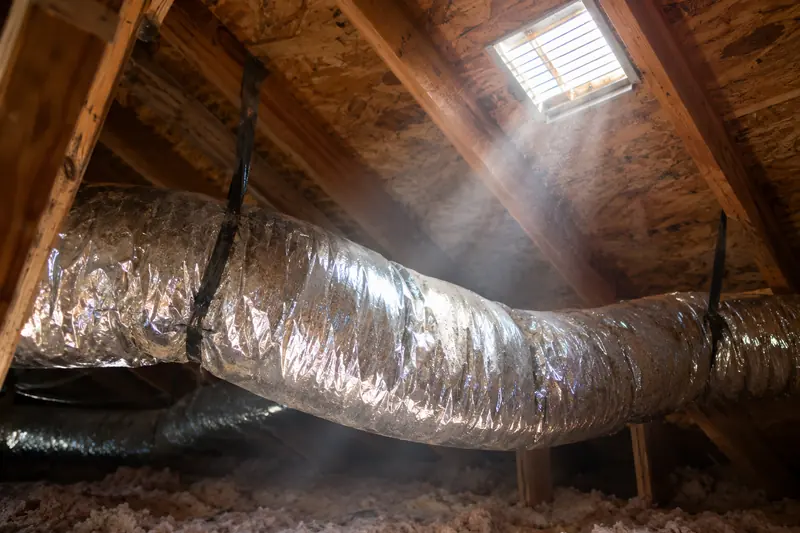
A duct leakage test turns a vague complaint, a back bedroom that never cools, into one number. In a Valley attic, which DOE's Building America program says "can easily reach 130°F or 140°F" on hot days, that number is cooled air handed to the hottest space on the lot.
What is a duct leakage test?
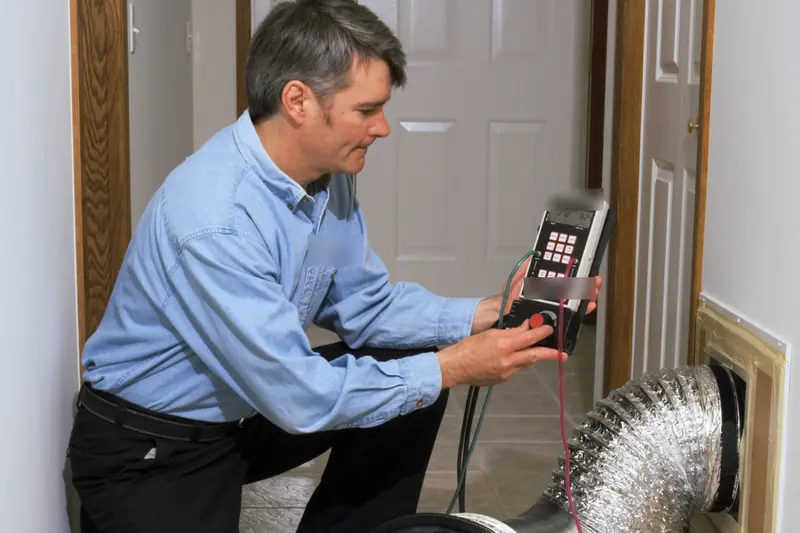
A duct leakage test is a fan pressurization test: a calibrated fan pushes air into the sealed-off duct system, and the airflow needed to hold a set pressure equals the leakage. The DOE Building America duct guideline describes a variable-speed blower with an orifice and pressure taps so the flow through it can be measured, with ASTM E1554 giving the detailed procedure. The guideline calls it a duct blower.
California's energy code writes the procedure into its Reference Appendix RA3, and that is the version that counts for a permit. The installer runs it, and a state-certified ECC-Rater (known as a HERS Rater under the 2022 code) verifies it; the rater visit page covers that second step.
How is a duct leakage test set up?
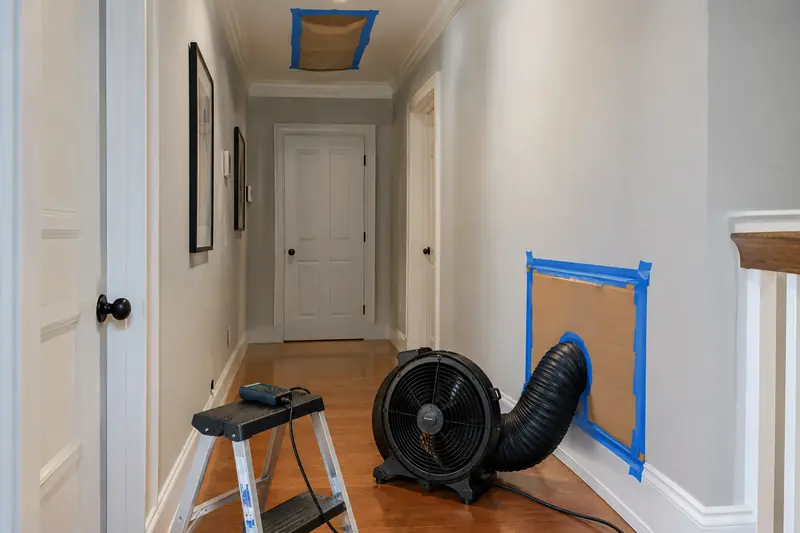
The setup starts by sealing every supply register and return grille except one large central return, where the fan attaches. The code text, reproduced on Energy Code Ace, allows the fan to connect at the air handler cabinet access panel instead.
With the HVAC system off, the tester brings the ducts to a positive 25 pascals (0.1 inch of water) with respect to outside and records the flow through the fan's flowmeter. That reading, in cubic feet per minute, is the leakage at 25 pascals, often written CFM25. The Building America guideline adds a practical warning: combustion appliances should be off before a house is pressurized or depressurized.
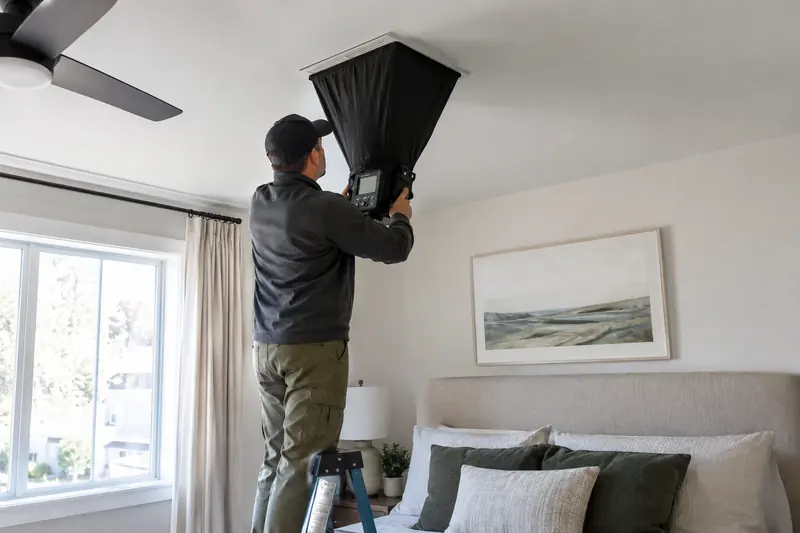
Before the test day, a homeowner's part is access. Clear the path to the air handler and the attic hatch, move furniture off floor registers, and keep pets in a closed room.
What is the difference between total leakage and leakage to outside?
Total leakage counts every hole in the ducts; leakage to outside counts only the holes that dump air beyond the living space. For the to-outside test, the code's procedure (RA3.1.4.3.4) attaches a blower door to an exterior doorway and brings the house to positive 25 pascals with respect to outside. The duct fan is then adjusted until there is zero pressure difference, within half a pascal, between the ducts and the rooms.
With no pressure difference between ducts and rooms, leaks into the house carry no air, so the fan flow is only what escapes outside. That is why Title 24 sets a lower limit, 7%, for leakage to outside than the 10% limit for total leakage. Leaks to outside cost the most energy: an LBNL presentation on remote duct sealing notes that for insulated ducts outside the envelope, 90% of the lost energy is not recovered.
What numbers should you expect from a duct leakage test?
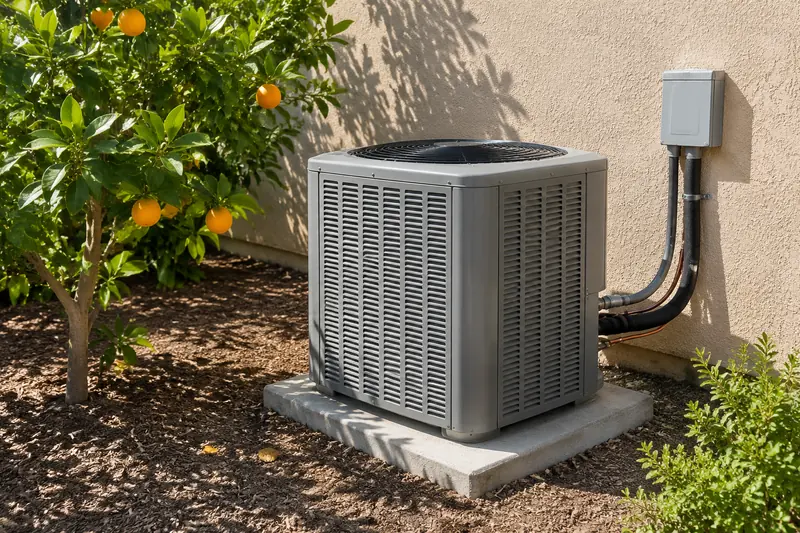
On an HVAC changeout, the passing numbers are 10% or less total leakage, or 7% or less leakage to outside, of system air handler airflow (§150.2(b)1E). The leakage flow is divided by the air handler airflow and turned into a percentage. When airflow isn't measured, the code's nominal value for a single split or packaged cooling system is 400 CFM per ton of condensing unit capacity; when even that is unknown, a default of 0.5 CFM per square foot of conditioned floor area is used.
Worked through for a 3-ton split system: nominal airflow is 1,200 CFM, so 10% is 120 CFM25 total and 7% is 84 CFM25 to outside. An entirely new or complete replacement duct system must reach 5%, which is 60 CFM25 on the same system. A measured airflow, when the rater has one, can replace the nominal figure.
Before sealing, many houses read far higher. ENERGY STAR's duct sealing page says about 20 to 30 percent of the air moving through a typical duct system is lost, and the Building America guideline says older homes often run 30% to 50%. The same guideline calls under 5% reasonable for newly installed systems and often not realistic for existing ones.
What can make a duct leakage test unreliable?
A test reads wrong when the setup is wrong: a register left unsealed counts as a leak, and a tape seal that lifts mid-test does the same. For the to-outside test, an open window or door spoils the house pressure. The airflow used as the divisor matters too, since a 10% result on nominal airflow can read differently against a measured figure.
Some tests should not be run at all. The EPA's single-family upgrade guidelines say: "Do not conduct air leakage tests (e.g., duct blaster tests) on ductwork that contains asbestos insulation." Homes built from the 1930s to the 1970s are more likely to have it, and Title 24 exempts asbestos ducts from the changeout rule. The EPA's asbestos page says not to touch suspected material and to have an accredited professional take samples.
A pressure pan test helps find the leakiest runs, but the Building America guideline says it is qualitative and can't quantify air leakage.
Should the ducts be tested before sealing?
Testing before sealing is optional outside a permitted job, and testing after sealing is what proves the work. The Building America authors write that it isn't necessary to quantify leakage before sealing, but testing shows how much improvement is possible and how much was achieved; when ducts are accessible, they say, seal them. On a changeout, the code requires the test either way.
Sealing tightens the system, and that can change pressures around a gas furnace or water heater. ENERGY STAR's duct sealing flyer tells contractors to check for backdrafting and run a combustion safety test after sealing. If you're unsure, call a licensed technician. If a CO alarm sounds or you smell gas, leave the building first and call 911 or the gas utility from outside. Sealing materials are compared on mastic vs foil tape, attic precautions on sealing attic ducts safely, and the symptoms on signs of leaky ducts.
Duct leakage test numbers
- 25 Patest pressure, about 0.1 inch of waterTitle 24 RA3 (Energy Code Ace)
- 400 CFMnominal airflow per ton for the mathTitle 24 RA3 (Energy Code Ace)
- 30–50%leakage common in older homesDOE Building America
- 90%lost attic duct energy not recoveredLBNL
| Test | Equipment | What it measures | Changeout limit |
|---|---|---|---|
| Total leakage (RA3.1.4.3.1) | Duct fan at a central return or the air handler | Every leak at 25 Pa, inside or outside | 10% of air handler airflow |
| Leakage to outside (RA3.1.4.3.4) | Duct fan plus a blower door in an exterior doorway | Only leaks beyond the living space | 7% of air handler airflow |
| Smoke test (RA3.1.4.3.5) | Non-toxic smoke injected at 25 Pa | Visible smoke from accessible leaks | Fallback when neither limit can be met |
| Pressure pan | Blower door and a pan over each register | Which runs leak most | Qualitative only, no limit |
How this page was put together
The test steps follow Title 24 Part 6 §150.2(b)1E and Reference Appendix RA3.1.4.2 and RA3.1.4.3 (2025 edition, as reproduced on Energy Code Ace), the DOE Building America duct sealing measure guideline (Aldrich and Puttagunta, 2011), ENERGY STAR's duct sealing page and flyer, LBNL's remote duct sealing slides hosted by the DOE, and two EPA documents (the 2021 single-family upgrade protocols and the asbestos page), all read in October 2026. The 3-ton example is arithmetic from the code's nominal airflow, not a measured house. Test equipment brands, rater fees and modeled savings figures were left out.
Questions from the field
What does CFM25 mean?
It is the airflow in cubic feet per minute that leaks from the ducts while they are held at 25 pascals. The test reports it, and the percentage comes from dividing it by the air handler airflow.
Why seal all the registers but one?
The registers are the ducts' intended openings. Sealing them means the only places air can leave are the leaks, and the one open return gives the fan a place to connect.
Does a high reading always mean an attic leak?
No. Total leakage includes leaks into the living space, which waste less energy. The leakage-to-outside test separates the two, which is why the code accepts either a 10% total result or a 7% to-outside result.
What if the house has asbestos duct wrap?
Don't test or disturb it. EPA guidance rules out leakage testing on asbestos-insulated ducts, Title 24 exempts asbestos ducts from the changeout sealing rule, and an accredited asbestos professional should take any samples.
Is a smoke test the same as a leakage test?
No. The smoke test shows where accessible leaks are but gives no percentage. Title 24 uses it as the fallback when ducts can't reach 10% total or 7% to outside after sealing.
More on testing