How Aerosol Duct Sealing Works
The short of it
Aerosol duct sealing blows sticky sealant particles through pressurized ducts so they build up and close small leaks from the inside; LBNL's field tests sealed about 80 percent of leakage, but disconnects still need hands.
Valley Home Ducts, figures checked against their sources · updated
On this page
What to carry away
- Researchers at Lawrence Berkeley National Laboratory developed inside-out aerosol duct sealing in the 1990s, according to the DOE Building America guideline (2011).
- In LBNL field tests on more than 100 single-family houses, some 80 percent of the leakage was sealed and register flows rose up to 7 percent.
- LBNL's own slides say the method seals holes up to about 1/2 inch across.
- Sealant is injected for about an hour while a computer tracks the leakage as it drops, LBNL reported in 1998.
- DOE Building America says aerosol cannot seal large holes or disconnected ducts; those need repair by hand first.
- ENERGY STAR lists aerosol-based sealant beside mastic and metal tape on its contractor checklist.
What is aerosol duct sealing?
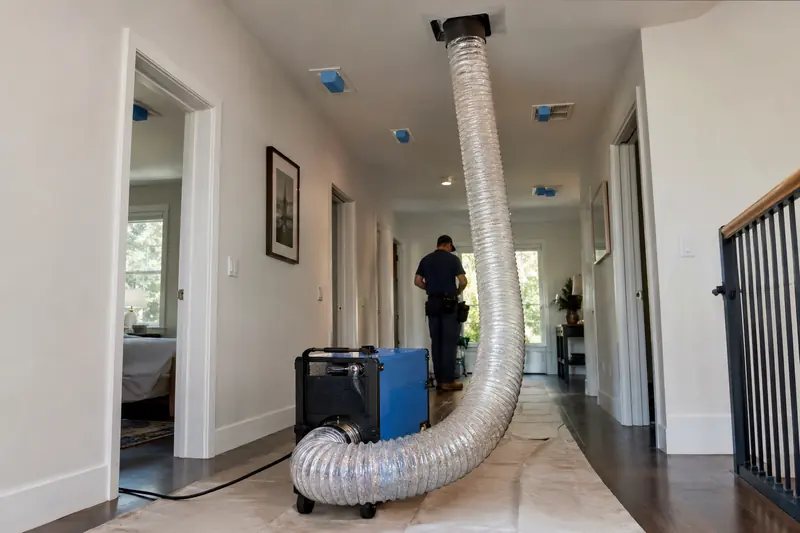
Aerosol duct sealing is a contractor process that seals a duct system from the inside by blowing a fog of sealant particles through it. Lawrence Berkeley National Laboratory built it for the leaks hand sealing cannot reach: ducts inside walls, between floors, or buried in a low attic corner. The LBNL research summary credits Mark Modera's group and says the project moved out of the laboratory in 1995.
The sealant is not a liquid. LBNL explains that liquids run, so the team chose a commercially available vinyl acetate delivered as sticky solid particles. The method is now sold commercially; Valley Home Ducts names no company.
How does sealant find the leaks?
The sealant finds leaks because leaks are the only way out. Before injection, the floor, wall and ceiling registers are covered, so air pushed into the ducts can escape only through gaps. Particles riding that air try to leave through each gap, stick first to its edges, then to one another, and the hole closes from the rim inward.
LBNL describes injecting for about an hour, with a computer calculating air loss and the sealing progress in real time. That running number is the useful part for a homeowner: the process starts and ends with a measured leakage figure, so you get a before-and-after reading instead of a promise.
By LBNL's account, the buildup happens where air is escaping, so the sealant collects at the leaks rather than lining every inch of sound duct.
What did the field tests show?
LBNL's field tests sealed some 80 percent of the leakage in more than 100 single-family houses, from New England to the Gulf Coast to the Nevada desert, and register flows increased up to 7 percent. Those are the lab's 1998 figures, reported in its own research review, not a forecast for any one house.
The lab's later slide deck, Remote Duct Sealing in Residential and Commercial Buildings (hosted by DOE, file dated 2008), adds three claims: the method seals holes up to about 1/2 inch across, the seal lasts 10 or more years, and the technique was patented in 1994. Read those as the developer's claims, since the slides also describe licensing the method to a company.
The same slides explain why attic ducts are the target. LBNL puts attic and crawlspace duct leakage at roughly 15 percent on each side of the fan and says that for insulated ducts outside the house, about 90 percent of the lost energy is not recovered. Air that leaks into a Valley attic in July is simply gone.
What can't aerosol duct sealing fix?
Aerosol duct sealing cannot fix disconnected ducts, large holes, crushed or kinked flex, poor support or a duct system that is the wrong size. DOE Building America states plainly that it cannot seal large holes or disconnects. A branch lying loose in the insulation will simply pour fog into the attic.
That is why a careful job starts with an attic inspection. A contractor reconnects fallen runs, patches big openings with sheet metal, and straightens crushed flex before injection; aerosol then handles the many small leaks left behind. If the system is undersized or the return is starved, sealing will not correct that; the Manual D sizing page covers design.
Asbestos is a stop sign, not a variable. The process pressurizes the ducts and measures leakage, and the EPA's Energy Savings Plus Health guidelines (2021) say not to run air leakage tests on ductwork that contains asbestos insulation. Suspect wrap or tape needs an accredited asbestos professional first.
Is aerosol duct sealing worth it for an attic system?
It is worth pricing when much of the leakage is out of reach, and less so when most joints sit in an open attic a contractor can crawl. DOE Building America's scoping advice says that if very few sections of duct are accessible, an aerosol sealant may be worth considering. In a single-story Valley ranch house with ducts strung across an open attic, hand sealing with mastic can reach most joints for less.
Many jobs combine the two: hand repairs for disconnects and big gaps, aerosol for the rest. Leakage limits still apply either way. When the air handler, outdoor unit or coil is replaced, Title 24 requires the connected ducts to test at 10 percent or less total leakage, or 7 percent or less to outside, per the 2025 code text on Energy Code Ace. A state-certified ECC-Rater, the title that replaced HERS Rater in the 2025 code, verifies the result; see the changeout page.
What should you ask before aerosol sealing?
Ask for numbers and for the safety steps by name. Useful questions:
- What is the measured leakage now, in CFM, and what was the reading at the end?
- Will disconnects, crushed runs and large holes be fixed by hand first?
- Will someone run a combustion safety test before and after, if the house has a gas furnace or water heater?
- If this is part of an equipment changeout, who arranges the ECC-Rater verification?
The third question matters. Tightening ducts changes air pressures in a house, and the ENERGY STAR duct sealing flyer tells contractors to check for backdrafting and run a combustion safety test after ducts are sealed. If you're unsure, call a licensed technician. Questions for any duct contractor are collected on the hiring page.
| Method | Reaches | Can't handle | Proof of result |
|---|---|---|---|
| Hand sealing with mastic or foil tape | Joints you can see and reach | Ducts inside walls, floors, tight eaves | Leakage test afterward |
| Aerosol sealing | Small leaks anywhere inside the system | Disconnects, holes over about 1/2 in., crushed flex | Computer reading during injection |
| Hand repair, then aerosol | Both | Design and sizing faults | Before and after readings |
| Duct replacement | Everything, with new duct | Cost and attic access | 5% or less test for a complete new system (Title 24) |
- 80%of leakage sealed in LBNL field testsLBNL
- 7%rise in register airflow, at mostLBNL
- 1/2 in.largest hole the method seals, LBNL's figureLBNL slides
- 90%of attic duct energy losses not recoveredLBNL slides
The hub for sealing and insulation compares aerosol with every other option, and the leakage test page explains the readings a contractor should hand you.
How this page was put together
Built from LBNL's 1998 research review on aerosol sealing, LBNL's remote duct sealing slides (energy.gov, 2008), DOE Building America's December 2011 duct guideline, EPA's Energy Savings Plus Health guidelines (May 2021), the ENERGY STAR flyer and Energy Code Ace's copy of the 2025 changeout rule, all opened in October 2026. Omitted: company and product names, prices and savings dollars; LBNL's 1998 price range is decades old and not Valley-specific.
Questions from the field
Does aerosol sealant coat the whole inside of the ducts?
LBNL describes particles sticking at the edges of leaks as air tries to escape, so the sealant gathers there. Ask the contractor to walk you through the setup before work starts.
Can aerosol sealing fix a duct that fell off its collar?
No. DOE Building America says it cannot seal disconnects or large holes. The duct must be reattached and secured by hand first.
How long does the sealing take?
LBNL described injecting sealant for about an hour. Prep, register covering, hand repairs and testing add time on either side.
How long does an aerosol seal last?
LBNL's slides claim 10 or more years. That is the developer's figure, so ask the contractor what their own warranty covers in writing.
Does aerosol sealing count for Title 24?
Title 24 sets the leakage result, not the method. Whatever the sealing method, the ducts must meet the test limit, and an ECC-Rater verifies it on a changeout.
Does aerosol sealing call for a combustion check?
Any duct sealing can change pressures around gas appliances. A combustion safety test by a qualified pro, run both before and after the work, checks for that; CO alarms belong on every floor.
Is it worth it for ducts in a crawlspace?
Crawlspace ducts lose energy much like attic ducts in LBNL's slides. Whether aerosol beats hand sealing depends on how much of the duct a contractor can reach.