Mastic vs Foil Tape on Ducts
The short of it
Mastic vs foil tape comes down to the joint: mastic is the first choice for most duct seams and rough connections, UL 181 foil tape suits straight seams and the air handler collar, and cloth duct tape suits neither.
Valley Home Ducts, figures checked against their sources · updated
This page links to PlumbingSupplyAndMore, which has the same owners as Valley Home Ducts. Those links are examples only; no figure here depends on them. About these links
On this page
What to carry away
- Use mastic sealant or metal tape, never duct tape: that is ENERGY STAR's short version.
- LBNL's 1998 study put 19 samples in an aging rig and 13 in a baking rig; only cloth duct tape failed.
- DOE Building America (2011) says many home energy experts rank mastic above tape in most situations.
- Gaps wider than about 1/8 inch call for fiber mesh tape set in mastic; gaps of about 1 inch or more need a sheet metal or duct board patch.
- Flex duct closures carry UL 181B marks: 181B-FX for tape and 181B-M for mastic, per the Air Duct Council standard.
- UL ratings cover strength and fire behavior, not service life, LBNL notes.
Is mastic or foil tape better for ducts?
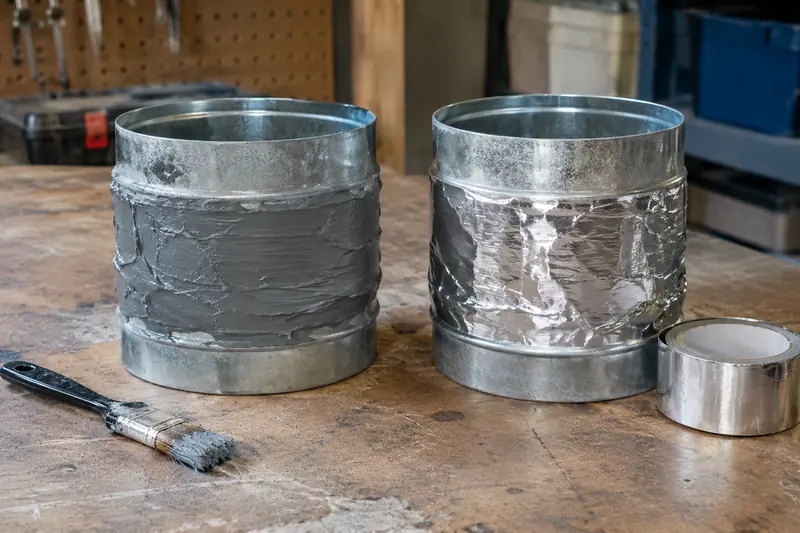
Mastic is better for most duct joints, and UL 181-listed foil tape is the acceptable second choice where a seam is straight and clean. The DOE Building America measure guideline (December 2011) describes mastic as a water-based paste that dries to a semi-rigid, waterproof coat and keeps some elasticity once cured, so it rides out the temperature swings and vibration of a working system.
Foil tape has a narrower job. The same guideline notes that thin foil tapes cannot follow curves or irregular shapes and puncture or tear on sharp metal edges. Tape is quicker and cleaner, which is its whole appeal; mastic takes longer and gets on everything, which is its only real drawback.
Both materials only seal. Neither one holds a duct up or holds a joint together, so a connection needs screws or a drawband first and a sealant second. A sagging run that pulls on its tape will open again no matter what the label says.
Why does cloth duct tape fail?
Heat and age break down the adhesive on cloth duct tape, and Valley attic ducts get plenty of both. Lawrence Berkeley National Laboratory tested this directly: its August 1998 article reports that of all the sealants the team aged and baked, only duct tape failed. Clear tapes, foil-backed tapes, mastics and an aerosol sealant held through the test period.
ENERGY STAR's duct sealing flyer repeats the rule in plain words: never use grey duct tape, since it does not last. The name is a historical accident. In this trade, "duct tape" is the one product not meant for ducts.
What do the UL 181 labels mean?
UL 181 labels tell you which kind of duct a tape or mastic is listed for: UL 181A covers closures for rigid ducts, and UL 181B covers flexible ducts and air connectors. The 2009 International Residential Code, as quoted in DOE's guideline, spells out the marks: 181A-P for pressure-sensitive tape, 181A-M for mastic and 181A-H for heat-sensitive tape on rigid fiberglass duct board, and 181B-FX for tape and 181B-M for mastic on flex.
The Air Duct Council's flex duct standard (5th edition, listed in the PNNL Building America Solution Center library) asks for tapes or mastics listed to UL 181B on flex connections. ADC has since published a 6th edition.
One limit matters here. LBNL points out that no UL rating addresses how long a duct sealant lasts. A UL mark means the product passed strength and fire tests, not that it will still be stuck in ten summers.
Where does duct mastic work best?
Duct mastic works best on any joint that is rough, curved, crowded or hard to see: collars where round branches meet a trunk, boots behind registers, sheet metal trunk seams and plenum corners. DOE Building America notes that mastic conforms to sharp or irregular edges where tape would rip or leak, and that it can go on by brush, caulk gun, trowel or gloved hand.
Small seams take mastic alone. For gaps wider than about 1/8 inch, the guideline's method is four steps: spread a layer of mastic over the gap, press fiber mesh tape into it, cover the mesh with more mastic, and stop when the mesh is barely visible. Gaps of roughly an inch or more are too large for tape and need a patch of sheet metal, duct board or other approved material first.
Be generous. The guideline warns that a very thin coat may not seal or last, and says to follow the maker's instructions for thickness and application temperature. Surfaces should be free of dust, grease and water, so wipe or vacuum a grimy joint before sealing. On insulated flex, the inner core is what gets sealed to the collar; sealing only the outer jacket leaves the leak in place.
A supply house sells water-based duct sealant by the gallon (PlumbingSupplyAndMore, same owners as Valley Home Ducts), the common pail size for a whole-attic job.
Where is foil tape the better choice?
Foil tape is the better choice on long straight seams and at the joint between the air handler and its plenum, where someone will need to cut the seal later. DOE Building America makes that point: tape can be cut and replaced easily when the unit is serviced or swapped, while cured mastic is very hard to remove.
Tape needs a clean, dry surface, firm pressure, and a temperature inside the maker's range; some tapes will not grip in the cold. The guideline also warns that foil tape edges are extremely sharp and suggests smoothing it with a plastic tool or gloved hand. Tape on duct board trunks often fails when it is asked to carry weight, so check that the duct is supported before relying on tape there.
Supply houses list aluminum foil HVAC tape (PlumbingSupplyAndMore, same owners as Valley Home Ducts) by width and length; check the roll for a UL 181A or 181B mark before it goes on a duct.
How do you apply mastic without making a mess?
Wear gloves and work one-handed. DOE Building America's practical tip is a cheap cotton or canvas glove under a disposable rubber glove on the sealing hand, leaving the other hand clean for the flashlight, ladder and tools. Cured mastic is very difficult to remove from skin and clothes, so dress for it.
The system should be off at the thermostat before you touch any duct, and attic work belongs in the cool part of the day; the attic safety page covers heat, footing, masks and the asbestos check that comes before any sealing. If you're unsure, call a licensed technician.
Once the sealant cures, a duct leakage test measures what the work achieved, and the R-value page covers putting insulation back over the sealed joints.
| Material | Where it fits | Weak point | Label to look for |
|---|---|---|---|
| Mastic (water-based) | Collars, boots, trunk seams, rough or curved joints | Messy; slow to apply | UL 181A-M or 181B-M |
| Mastic plus fiber mesh | Gaps wider than about 1/8 in. | Not for gaps near 1 in. or more | UL 181 listed mastic |
| Foil tape | Straight seams, air handler to plenum | Tears on sharp edges; needs clean, dry metal | UL 181A-P or 181B-FX |
| Cloth duct tape | Nothing on a duct | Only sealant that failed LBNL's aging test | None for ducts |
- 19sealant samples in LBNL's aging rigLBNL (1998)
- 1/8 in.gap width where mesh tape joins masticDOE Building America
- 20–30%typical leakage, as a share of duct airflowENERGY STAR
- 181BUL standard for flex duct tape and masticAir Duct Council via PNNL
The stakes are not small: ENERGY STAR's estimate for typical leakage runs 20–30% of the airflow a system moves. The sealing and insulation hub lines up every method side by side, and the aerosol sealing page covers the leaks no hand can reach.
How this page was put together
Sources read in October 2026: DOE Building America's measure guideline for existing-home ducts (December 2011), LBNL's duct tape article (August 17, 1998), ENERGY STAR's web page and flyer on duct sealing, and the Air Duct Council flex duct standard (5th edition) as listed by PNNL. Not included: brand names and prices, and any claim that one tape outlasts mastic, since no UL rating covers service life.
Questions from the field
How thick should duct mastic be?
Follow the maker's instructions on the pail. DOE Building America adds that if anything, err generous: a very thin coat may not seal or hold up.
Can mastic go over old cloth duct tape?
Old cloth tape is a poor base because its adhesive is already failing, and mastic needs a clean surface. Peel loose tape off, wipe the joint, then seal the metal itself.
Is butyl tape different from foil tape?
DOE Building America describes butyl duct tapes as pricier, with a thicker adhesive that resists tearing and conforms better to irregular surfaces. Check that any tape carries a UL 181 mark.
Does mastic work on flex duct?
Yes, when it is listed to UL 181B (marked 181B-M). Seal the inner core to the metal collar after securing it with a drawband, not just the outer jacket.
How long does mastic take to dry?
Drying time depends on the product, temperature and coat thickness, so read the label. Wait until it has set before covering the joint with insulation, as DOE's sequence advises.
Why not seal the filter slot with foil tape?
Taping the slot shut blocks access to the filter, which DOE Building America calls usually unacceptable. DOE describes after-market covers that use magnets or removable gaskets, and a technician can advise on one.
Do I need to seal ducts inside the house too?
Leaks to conditioned rooms waste less energy than leaks into the attic. DOE Building America says to focus on ducts in unconditioned space and near the air handler first.
Back to the Valley Home Ducts front page