Signs of Leaky Ducts
The short of it
Signs of leaky ducts include high summer and winter bills, rooms that are hard to cool, stuffy or dusty rooms, and kinked or tangled flex duct, but only a duct leakage test measures how much is lost.
Valley Home Ducts, figures checked against their sources · updated
On this page
What to carry away
- ENERGY STAR's list of warning signs: high bills in summer and winter, rooms that are hard to heat and cool, stuffy rooms, ducts in the attic, crawlspace or garage, and tangled or kinked flex.
- In older homes, duct leakage of 30–50% of total system airflow is not uncommon, according to DOE Building America (2011).
- PNNL's Building America Solution Center says sagging or pinched flex can cause minimal airflow at a register, excess noise or fan burnout.
- ENERGY STAR says many systems have return ducts that are too small.
- Closing registers raised energy use in a typical California house in an LBNL study (Walker, 2003), so it is not a fix for uneven rooms.
- A California equipment changeout triggers a required duct test: total leakage no higher than 10%, or leakage to outside no higher than 7%.
Leaky ducts rarely announce themselves. The coil works, the fan runs and cold air comes out of most registers, so the losses show up sideways: in a bill, in one bedroom, in dust. This page sorts the clues into what you notice, what you can check from inside the house without tools, and what a look in the attic can show, then explains when a measured test is worth paying for.
How leaky ducts show up
- 20–30%typical share of duct airflow lostENERGY STAR
- 30–50%leakage not uncommon in older homesDOE Building America
- 20%possible efficiency loss from leaky ductsENERGY STAR
- 3 monthslongest filter change intervalENERGY STAR
What are the common signs of leaky ducts?
The common signs of leaky ducts are high summer and winter bills, rooms that are hard to heat and cool, stuffy rooms, and flex duct that is tangled or kinked, according to ENERGY STAR's duct sealing page. The same list adds a sign that most Valley homes share: ducts located in an attic, crawlspace or garage.
ENERGY STAR's flyer asks the question in three parts, "High utility bills? Stuffy rooms? Dusty house?", and says leaky ducts can reduce heating and cooling efficiency by as much as 20 percent. Each of those signs has other possible causes, from a dirty filter to west-facing windows, which is why the list is a reason to look closer rather than a diagnosis.
Why is one room always hotter?
One room is usually hotter because it gets less cool air than it needs or loses it on the way, and the far end of a long attic duct run is where both happen. A back bedroom fed by a long flex branch has more duct surface in the hot attic, more joints to leak and more places for the flex to sag.
The Building America Solution Center notes that sagging or pinched flex can cause minimal airflow at a register, excessive noise or fan burnout from higher static pressure. Return air matters too: ENERGY STAR says many systems have return ducts that are too small, and a bedroom with its door shut and no return path may not take in much supply air.
Closing registers in cooler rooms to push air to the hot one is a common move that backfires. An LBNL study of register closing found it led to increased energy use for a typical California house with ducts outside the conditioned space. Registers and balancing and return air cover the better options.
What can you check from inside the house?
From inside, you can check the filter, the registers and the return grilles without opening any equipment. Switch the system off at the thermostat first. ENERGY STAR advises that you check the filter every month and change it at least every 3 months; a clogged filter cuts airflow and can mimic a duct problem.
With the system running, walk the house and hold a hand at each register. A register with weak flow compared with similar rooms points to that branch: crushed, disconnected or simply long. Note which rooms are always warm, at what time of day, and whether the door being open changes it. That record is useful to a contractor or rater later.
Do not open the air handler or furnace cabinet beyond the filter door; there are live electrical parts inside. If the house has a gas furnace or water heater, a CO alarm on every level is worth having before any duct work starts. If you're unsure, call a licensed technician.
| Clue | Possible duct cause | Who can check |
|---|---|---|
| High summer and winter bills | Leakage and heat gain in attic ducts | Duct leakage test by a contractor or rater |
| One room always hot | Long, sagging or crushed branch; too little return | Homeowner (register airflow), then contractor |
| Stuffy rooms | Low supply airflow or no return path | Contractor airflow measurement |
| Dusty house | Return leaks pulling in attic or crawlspace dust | Contractor inspection and test |
| Kinked or tangled flex in the attic | Restricted airflow | Visible from the attic hatch |
What can you see in the attic?
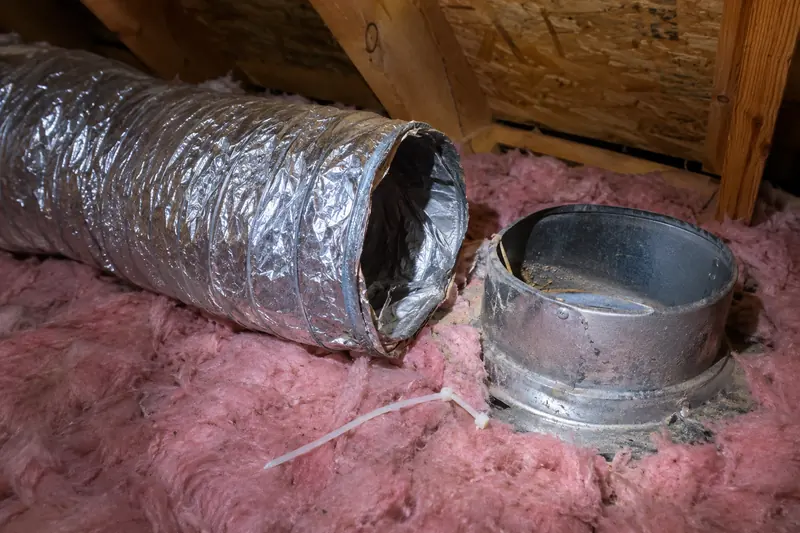
In the attic you can often see the big problems: a flex branch that has slipped off its collar, a run flattened by a stored box or a footstep, a torn outer jacket, or flex that loops and sags between straps. ENERGY STAR's flyer lists kinks in flexible ductwork restricting airflow among the problems a contractor should fix. What you cannot see are the small gaps at joints and seams that add up to most leakage.
Look from the hatch first. If you go further, do it only in the early morning of a cooler month, since the DOE Building America guideline says hot-day attics reach 130–140°F. Step only on joists or a board laid across them, never between, watch for roofing nails overhead, wear gloves, long sleeves, safety glasses and a dust mask, bring water and tell someone you are up there.
In a home built roughly from the 1930s through the 1970s, white or gray wrap on ducts, or cement-like round ducts, may contain asbestos. EPA advice is not to touch suspect material and to have an accredited asbestos professional take samples.
When do you need a real test?
You need a measured duct leakage test when you want a number, before paying for sealing, and whenever California code requires one. Replacing an air handler, outdoor condensing unit or coil triggers Title 24's duct sealing rule, with limits of a 10% ceiling on total leakage or 7% on leakage to outside, verified by a state-certified ECC-Rater (the title that replaced HERS Rater).
A test also tells you whether the work paid off. The Building America guideline calls under 5% a reasonable goal for newly installed systems and often not realistic for existing ones, so a before-and-after pair of numbers is the fair way to judge a sealing job. How a duct leakage test works explains the equipment and the result, and the Attic heat row links the rest of this topic, including why attic ducts lose so much cooling.
How this page was put together
This page is based on ENERGY STAR's duct sealing page, heating and cooling page and duct sealing flyer; the DOE Building America measure guideline on existing-home ducts (2011); PNNL's Building America Solution Center page on flex duct support; LBNL's register-closing study (Walker, 2003); EPA's asbestos guidance; and California's 2025 Energy Code as posted by Energy Code Ace. All were read in October 2026. Not included: do-it-yourself pressure tests, smoke pencils near gas appliances, and any claim that one sign proves leakage.
Questions from the field
Can a smart thermostat tell me my ducts leak?
No. A thermostat reads the temperature where it hangs, not the airflow at each register or the air lost in the attic. Only a duct leakage test measures leakage.
Does a dusty house mean my ducts leak?
It can. ENERGY STAR's flyer names a dusty house as a possible duct clue and says sealing helps keep pollutants from dusty attics and musty crawlspaces out of the ducts. A test is what confirms it.
Will duct cleaning fix a dusty house?
EPA says studies do not conclusively show that dirty ducts raise dust levels in homes, and it finds no proof that cleaning heads off health problems. Sealing return leaks and changing filters address the likelier sources; duct cleaning claims has EPA's full list.
My house is new. Can the ducts still leak?
Yes. Title 24 testing for new and replacement duct systems exists because new ducts can leak too; a complete replacement duct system must test at 5% or less.
Should I seal visible leaks before a test?
If the system is about to be replaced, let the contractor and rater run the test first, so the result reflects the whole system and the sealing that follows.
Does a leak in the garage count?
Yes, and it is a special case. Title 24 applies a 6% limit, or sealing all accessible garage leaks, when altered ducts or equipment are in a garage, regardless of how much duct was changed.
More on attic heat